Related Posts

Related Posts Plugin for WordPress, Blogger...

Top Ski Resorts of Canada

Canada, one of the best places for ski resorts; know about the best Canadian ski resorts, how many runs they have, longest run, terrain park, etc.

Fantastic Five Adventure Travel Destinations

Enjoy the snow covered peaks like the Alps, Himalayas, etc. on your next mountaineering trip.

Amazing Indoor Water Parks Around the World

Indoor water parks provides the same spin and splash fun that one gets in the water. It is worth visiting these indoor water parks once in your lifetime.

Roadside Attractions around the world

Do you think there is nothing much to see on the roads? It is time to change this view; take a look at these remarkable roadside attractions.

Best National Parks of Canada

Banff National Park, Gros Morne National Park and much more about hot springs, wildlife viewing, best time to visit, etc

Showing posts with label Europe. Show all posts

29 October, 2012

10 Famous Inclined Towers or Leaning Towers around the World


Leaning Towers, also called as “Inclined Towers” are towers that are intentionally built to lean or incline over an angle. When talking about leaning towers, the first tower that comes to our mind is the world famous Leaning Tower of Pisa or Torre di Pisa, Italy. The fact is that this leaning tower was not intentionally built to lean. Presenting below are some of the famous inclined towers around the world.

10. Leaning Temple of Huma, Orissa, India

Leaning Temple of Huma, the only leaning temple in the world
Want to see the only leaning temple in the world? If yes, come and visit the Leaning Temple of Huma dedicated to Lord Shiva in India in the state of Orissa, now, called as Odisha.  It is not sure whether this temple was constructed this way on purpose or is a fault with the design. If you visit this temple, you can notice that it is the edifice that is leaning and not the pinnacle of the temple. It is believed that this temple was built by Emperor Anangabhima Deva-III, but later either rebuilt or renovated by King Baliar Singh. Plan a visit to this temple during March if you wish to see the annual fair, which will be held to commemorate Shivrathri, a famous Hindu festival.

9. Leaning Tower of Nevyansk, Nevyansk, Russia

Leaning Tower of Nevyansk, Russia

Courtesy: Wikimedia
Leaning Tower of Nevyansk is believed to be built in the 18th century (anywhere between 1725 and 1732); however, information on when this leaning tower was constructed is not known. It is a 189 feet tall tower with a right angle inclination of 7 feet 3 inches from the top of the tower. As the answer to the question of when it was built is a mystery so is the purpose of the tower. There are many debates on the purpose of the tower, which includes a watchtower, bell tower, prison, laboratory, etc. It is a popular belief that the inclination towards to southwest is to symbolize the birth of Demidov. Even though much of the information about the tower is not known, it is the first tower in the world with cast iron cupola.

8. Sharps Island Light, Tilghman Island, Maryland

Sharps Island lighthouse, endangered lighthouse in Maryland
Sharps Island lighthouse is the third lighthouse in Maryland and was built using cast iron. The lighthouse is 35 feet tall and leans at an angle of 15 degrees. This was automated in the year 1938 and was later deactivated in 2010. This is one of the picturesque lighthouses as well as poorly maintained. Sharps Island lighthouse got a place for itself in the National Register of Historic Places in July 1982 and is one of the endangered lighthouses.

7. Leaning Tower of Niles, Touhy Avenue, Illinois

Leaning Tower of Niles, an exact replica of Leaning Tower of Pisa, Italy
Are you trying to visit Paris to see the Leaning Tower of Pisa, but unable to do so; how about seeing a replica of it? Yes…Leaning Tower of Niles is a replica of Leaning Tower of Pisa and ½ the size of it. The original idea of constructing this tower was to store water for outdoor swimming pools. This was constructed by industrialist Robert Ilg. He built it as a part of Recreation Park for his employees. This tower now holds 4 fountains and a swimming pool of 30 feet.

6. Olympic Stadium, Montreal, Quebec, Canada

Olympic Stadium, Canada's highest seating capacity stadium
It is a doughnut shaped multi-purpose stadium built to host the 1976 Summer Olympics in Canada; it is nicknamed as the “Big O” due to its shape. This has a record of being the stadium with highest seating capacity in Canada. It was used as football and baseball stadium for some time, but now mainly used to conduct special events. This is the tallest inclined tower in the world.

5. Gate of Europe, Madrid, Spain

Gate of Europe, the world's first inclined skyscraper and Spain's second tallest twin tower
Gate of Europe is the first inclined skyscraper in the world and the second tallest twin towers in Spain. Each of these buildings is 115 meter tall and is inclined at an angle of 15 degrees. Both these towers have a rooftop helicopter pad. These were designed by American architects Philip Johnson and John Burgee.

4. Tiger Hill Pagoda, Suzhou City, China

Tiger Hill Pagoda nicknamed the "Leaning Tower of China"

Courtesy: Wikimedia

Tiger Hill Pagoda is a Chinese pagoda situated in the Suzhou city of China. It is popularly known as the “Leaning Tower of China” and was built during the “Five Dynasties” period. The pagoda is 154 feet tall with an inclination of roughly 3 degrees; this inclination is due to the fact that the foundation of the pagoda is half rock and half soil.

3. Leaning Tower of Suurhusen, Suurhusen, Germany

Leaning Tower of Suurhusen, the world's most tilted tower unintentionally tilted, Germany

Courtesy: Wikimedia
According to the Guinness World Records, Leaning Tower of Suurhusen holds the record of the most tilted tower in the world till 2010; however, it is still the world’s most tilted tower that was unintentionally tilted. The tower inclines at an angle of 5.194 degrees, which is 1.22 degrees more than the Leaning Tower of Pisa, Italy. This is a British Gothic church built in the Middle Ages in a marshy land; the church tilted when the water in the marshy land dried in the 19th century.

2. Capital Gate, Abu Dhabi, UAE

Capital Gate, Abu Dhabi - the world's furthest leaning man-made tower

Courtesy: Wikimedia
Capital Gate claims the record of “World’s furthest leaning man-made tower” from Guinness World Records and leans at an angle of 18 degrees westwards. The building is currently owned by Abu Dhabi National Exhibitions Company. This is the first building in Middle East to diagrid technology; diagrid technology absorbs and channels the force created by wind as well seismic pressure.

1. Leaning Tower of Wanaka, Wanaka, New Zealand

Leaning Tower of Wanaka in Puzzling World, New Zealand

Courtesy: Flickr
Puzzling World is one of the famous tourist attractions in Wanaka, New Zealand. When started in 1973, it just had a maze; however, this is a place full of optical illusions, puzzles that visitors can solve, hologram hall, tilted house, and much more. The Leaning Tower of Wanaka was made to tilt at an angle of 53 degrees by pulling the building out of ground and balancing on one corner.

You will be amazed to look at these amazing leaning towers or inclined towers in the world!

31 July, 2012

5 Must See Monuments and Memorials in Paris


Paris, the capital and the largest city in France is home for nearly 3,500 historical monuments and four UNESCO World Heritage Sites. Here are some of monuments and memorials in Paris that you must not miss when visiting Paris.

Arc de Triomphe

Arc de Triomphe with the French Flag (Best example for Neoclassical architecture)
Arc de Triomphe is a 164 feet high monument and one among Paris’s most famous monuments. This monument is one of the finest examples of Neoclassical architecture style. The commissioning of Arc de Triomphe began in 1806; however, the entire construction was completed only in 1836 as the construction was halted for various reasons. The masterminds behind this famous monument are Jean Chalgrin, Louis-Etienne Hericart de Thury. Arc de Triomphe holds a lot of sculptures, reliefs, details about some of the great battles, etc. With the help of a lift, visitors can reach the top of the monument and can get a panoramic view of the Paris city (one has to climb the last 46 steps).

Cleopatra’s Needle

Cleopatra's Needle or Luxor Obelisk
Cleopatra’s Needle is an ancient Egyptian obelisk and is re-erected in three cities, namely, London, Paris and New York. If you think this has any connection with Queen Cleopatra of Egypt, it is not so. They were already more than thousand years old when Queen Cleopatra was alive. Cleopatra’s Needle at Paris once served as the entrance to the Luxor Temple. Cleopatra’s Needle is also sometimes referred as “Luxor Obelisk.” It is 23 meters high and is made of red granite. The total weight of the obelisk is believed to be 250 tonnes.

Flame of Liberty

Flame of Liberty, above the tunnel of Pont de l'Alma where Princess Diana died in an accident
One can notice a torch with flame in the hands of Statue of Liberty, one of the wonders of the world at the New York City; Flame of Liberty is a gold leaf covered replica of the flame in the torch. This monument is 3.5 meters high and is located in the 8th arrondissement. International Herald Tribune offered this to represent the celebration of 100 years (completed in 1987) of publishing an English language newspaper in Paris in 1989. This also served as a token of friendship when the restoration work in the Statue of Liberty took place. This is one of the major tourist attractions for Diana followers after she died in an accident in a tunnel beneath Pont de l’Alma.

July Column

Colonne de Juillet with the three glorious (Trois Glorieuses) dates of July
July Column (Colonne de Juillet) is yet another famous monument in Paris that commemorates “Trois Glorieuses” or the “Three Glorious” days in the month of July during the Revolution of 1830 when the “July Monarchy” of Louis-Philippe commenced with the fall of Charles X of France. this project actually started to commemorate the “Fall of the Bastille” in the year 1792; however, the project did not get past the foundation laying stage. It is 154 feet high and weighs 74,000 kilograms.

Pantheon, Paris

Pantheon de Paris, a church converted as a mausoleum
When said Paris, can anyone forget Pantheon? Yes, Pantheon (located in the 5th arrondissement) is one of the must see mausoleum in Paris; this was initially built as a church that was dedicated to St. Genevieve and for her relics. This is yet another best example for Neoclassical architecture styles. The masterminds behind this famous mausoleum are architects Jacques-Germain Soufflot and Jean-Baptiste Rondelet.


27 July, 2012

7 Splendid Parks in Paris


Paris is a great city in France with so many interesting, beautiful and worth visiting places like parks, gardens, monuments, canyons, fountains, etc. Paris is known as “City of Lights” and also as “Capital of Fashion.” Paris is divided into 20 districts; these districts are called “arrondissement.” Each and every arrondissement has its own tourist attractions; here is a sneak preview of some of the brilliant looking parks in Paris.

Name of the Park: Parc de Belleville
Location: 20th arrondissement

Parc de Belleville, the highest park in Paris
Parc de Belleville is the highest park in Paris as it is situated at a height of 108 meters on the Belleville hills; architect Francois Debulois and landscaper Paul Brichet are the masterminds behind the idea of this park. This is the best place to get the panoramic view of the city.

What it offers to visitors? 
  • The longest fountain in Paris (100m long)
  • Wooden playground for kids
  • More than 1000 varieties of trees and shrubs
  • Open-air theatre
  • Ping-Pong tables
  • Maison de l’Air – a museum that teaches visitors about pollution and how important fresh air is
  • Display of annual flowers

Opening Hours *

Park is open throughout the year; however, the opening and closing time changes according to the weather. Closing time varies from as early as 5:30 p.m. to as late as 9:30 p.m.

Weekdays – Opens at 8 a.m., weekends – opens at 9 a.m.

Closing Hours

November 16 to January: closes at 5:30 p.m.
February, November 1 to 15: closes at 6:00 p.m.
March: closes at 7:00 p.m.
October: closes at 8:00 p.m.
September: closes at 8:30 p.m.
April 15 to May 15: closes at 9:00 p.m.
May 16 to August 31: closes at 9:30 p.m.

Entrance Fee: *

Adults – 2 Euros
Persons aged 7 and 25 – 1 Euro
Children under 7 years of age – Free

Name of the park: Parc des Buttes Chaumont
Location: 19th arrondissement

Parc des Buttes Chaumont, third largest park in Paris
Parc des Buttes Chaumont is the third largest park in Paris and is a public garden. This park was a gypsum and limestone quarry, which was later converted to a park. This park is the brainchild of engineer Jean-Charles Alphand, horticulturist Jean-Pierre Barillet-Deschamps and architect Gabriel Davioud. The park has 5 large gates and 7 smaller gates.

What it offers to visitors? 
  • Cliffs, bridges (63 m long suspension bridge called the suicide bridge), man-made streams
  • Grotto with a 20m high waterfall
  • Playgrounds for children, outdoor terrace, roller rink
  • English and Chinese gardens
  • Belvedere of Sybil
  • Exotic trees
  • Restaurants, theatres, and Waffle Stands

Opening Hours

The park is opened all through the year; it opens at 7 a.m. regardless of the season.

Closing Hours

November through March: 9:00 p.m.
April through October: 11:00 p.m.

Entrance Fee *

There is no entrance fee; however, to access the island by boat, fee has to be paid.

Name of the park: Parc de la Villette
Location: 19th arrondissement


Parc de la Villette, designed by architect Bernard Tschumi is one of the largest parks in Paris. Bernard Tschumi actually won a design competition for the park; however, many other architects have played a major role in the construction of concert halls, museums, theatres, etc. It is estimated that nearly 10 million people visit Parc de la Villette in a year.

What it offers to visitors? 
  • Cite des Sciences et de l’Industrie, Europe’s largest science museum
  • Cite de la musique
  • 6,300 seat capacity concert arena called “Le Zenith” (the largest concert arena in Paris)
  • Playgrounds for children
  • 35 architecture follies
  • Bamboo garden and themed gardens include the garden of equilibria, the garden of islands, the shadows of the gardens, garden of childhood fears, etc.


One has to buy tickets for the shows and workshops held at Parc de la Villette, which can be done either by visiting their website or calling them up over the phone.

Name of the park: Parc Andre Citroen
Location: XVe Arrondissement

Th walkway at the Parc Andre Citroen
Parc Andre Citroen was named after the founder of the company called Citroen automobile manufacturing plant, Andre Citroen as this public park was built on the site where the automobile manufacturing plant was earlier. It is a 14 hectare public park that was designed by architects Patrick Berger, Jean-Paul Viguier and Jean-Francois Jodry.

What it offers to visitors? 
  • Six serial gardens where each garden is associated with a planet, a metal, a sense, a day in a week, and a state of water
  • Garden in Movement, the wild grasses in the garden move or respond to the difference in the speed of wind velocity
  • A moored gas balloon that offers picturesque view of various historical places of Paris like River Seine, Notre Dame de Paris cathedral, Champ de Mars, etc.
  • Fountains and greenhouses
  • Play area for children in the white and black garden

Opening Hours *

May through September: 9:00 a.m. on all days

Closing Hours *

May through September 8:30 p.m. on all days

Entrance Fee *

The entry to the park is free.

Name of the park: Parc Montsouris
Location: 14th arrondissement

Parc Montsouris, a public park ordained by Napoleon III and Baron Haussmann
Parc Montsouris is a 15 hectares public park ordained by Napoleon III and Baron Haussmann. This park resembles an English garden, which is quite popular genre during 19th century.

What it offers to visitors? 
  • A water reservoir on the northeast side of the park offers an entrance to the famous Paris catacombs
  • Wonderful flora and fauna
  • Bronze and marble sculptures
  • Children playgrounds and ping-pong tables
  • Snack and refreshment centers

Opening Hours

May through August: 8:00 a.m. on weekdays and 9:00 a.m. on weekends

Closing Hours

May through August: 9:30 p.m. on all days including weekends

Entrance fee

They do no charge anything as an entrance fee.

Name of the park: Parc de Bercy
Location: 14th arrondissement

Parc de Bercy, a park that contains a cluster three connected gardens
Parc de Bercy is a 14 hectare area park and one of the important parks in Paris; it is a set or cluster of three connected gardens designed by various well-known architects like Bernard Huet, Jean-Pierre Feugas, Philippe Raguin, etc.

What it offers to visitors? 
  • Three gardens called Romantic Garden, Flowerbeds and Meadows
  • Playgrounds, pony rides, ping-pong, etc.
  • Eateries and water points

Opening Hours

May through August: 8:00 a.m. on weekdays and 9:00 a.m. on weekends

Closing Hours

May through August: 9:30 p.m. on all days including weekends

Entrance fee

They do no charge anything as an entrance fee.

Name of the park: Parc Monceau
Location: 8th arrondissement

Parc Monceau, an English style park in Paris
Parc Monceau is a 8.2 hectares public park and was designed by Louis Carrogis Carmontelle, a famous writer and painter. It is an English style park with informal layout and curved walkways.

What it offers to visitors? 
  • Playgrounds for children, swings and small carousel
  • Eateries and water points
  • Exotic trees and birds

Opening Hours

May through August: 7:00 a.m. on all days including weekends

Closing Hours

May through August: 10:00 p.m. on all days including weekends

Entrance fee

They do no charge anything as an entrance fee.

Make sure you visit these parks, which are an important tourist destination in Paris when planning a visit to Paris.


07 May, 2012

10 Beautiful and Stunning Sea-Stack Formations


When talking about beautiful geological landforms stacks definitely hold an important place. Stacks are formed due to a variety of natural phenomena like wind, water and time; hydraulic actions during erosion play a vital role in the formation of sea stacks. They have steep and vertical columns of rock in the sea. These can be found very close to the coast of the sea. Stacks are a popular destination of rock climbing.

Ball’s Pyramid, Lord Howe Island, Australia

Ball's Pyramid, erosional remains of shield volcano and a caldera.
Ball’s Pyramid is in reality the erosional remains of a shield volcano and a caldera; caldera is created when a land collapses due to volcanic eruption. It got its name as it was discovered by Lieutenant Henry Lidgbird Ball in the year 1788; it was he who discovered the Lord Howe Island around the same period. Ball’s Pyramid is 1,844 feet high and therefore the world’s tallest volcanic stack.

Old Man of Hoy, Orkney Islands, Scotland

Old Man of Hoy, A prominent landmark when ferrying from Thurso to Stromness
Old Man of Hoy is a 449 feet high red sandstone sea stack in the Orkney Islands of Scotland. This is a prominent landmark when ferrying from Thurso to Stromness. There were no indications of a sea stack in the maps drawn between 1600 and 1750; this leads to the belief that this was discovered 400 years back. This sea stack is in the verge of collapsing.

Old Man of Stoer, Sutherland, Scotland

Old Man of Stoer, a famous climbing route in Scotland
Old Man of Stoer is a 197 feet high sea stack close to the villages of Culkein and Stoer. Old Man of Stoer is famous for its climbing route; however, it is believed that it is very tough to climb when the weather is windy.

Lange Anna, Heligoland, Germany

Lange Anna, famous tourist attraction and a natural monument of Germany
Lange Anna is also called as Long Anna or Tall Anna; it is 154 feet high sea stack in the North Sea island of Heligoland in Germany. It is a point of tourist attraction in Germany; however, tourists are not allowed to climb the rock. Lange Anna in many ways resemble Old Man of Hoy sea stack of Scotland. Lange Anna was declared natural monument of Germany in the year 1969.

The Twelve Apostles, Victoria, Australia

The Twelve Apostles, a popular limestone sea stack tourist attraction
These are a group of Miocene limestone rocks with a height of 147 feet; these are one of the most popular tourist attractions in Australia. These were called as the Sow and Piglets until 1922; it was changed to The Twelve Apostles for tourism purposes even though there are only nine sea stacks. These rocks are in the verge of collapsing and already one stack collapsed on July 2005. Helicopter tours are arranged for tourists and are believed that nearly two million people visit this site.

Sugar Loaf, Mackinac Island, Michigan

Largest post-glacial erosion feature of this island
Sugar Loaf, a place for ritual burials in the earlier periods and now a famous tourist attraction
Doesn’t the name sound yummy? Sugar Loaf is a sea stack in the Mackinac Islands and is 75 feet high and is believed to be the largest post-glacial erosion in the Straits of Mackinac. This consists of resistant limestone rock consisting of various broken mineral fragments. Why is it called Sugar Loaf? People who live near the frontier Great Lake loves maple sugar, which is packed in cone-shaped baskets; as the rock resembles this shape, the rock got its name as Sugar Loaf. In earlier periods, this area was used for ritual burials.

Ko Tapu, Phang Nga Bay, Thailand

Ko Tapu, became a popular tourist spot after featuring in a James Bond movie
One can witness the Ko Tapu sea stack in the Khao Phing Kan or ko Khao Phing Kan Islands of Thailand. These islands are popularly known as the James Bond islands after featuring in a James Bond movie.

Ko Tapu is a 66 feet high limestone rock; the diameter of this sea stack increases by 4 meters from 13 feet and by 8 meters from 26 feet. There is a local legend about Ko Tapu’s formation. It explains that a fisherman once didn’t get any fishes even after numerous attempts and got only one nail. It seems he kept throwing this nail and catching it and finally cut the nail into two halves as he was very furious that he was not able to catch a single fish. One half of this cut nail rooted itself and became the Ko Tapu sea stack. There is also a scientific theory explaining the formation of Ko Tapu which is the constant erosion.

Hopewell Rocks, New Brunswick, Canada

The Flower Pot Rocks or The Rocks
Hopewell Rocks, on the bottom of the Atlantic Ocean
Hopewell Rocks is known by various other names like “The Flowerpot Rocks” or “The Rocks.” This is a sandstone rock. You can find these sea stacks at the upper reaches of Bay of Fundy at Hopewell Cape. This area experiences a heavy tidal range and therefore the base of these rock formations get covered with water almost two times a day.

Old Harry Rocks, Dorset, England

A view of Old Harry from the north Studland Bay

Image source
These are a set of two chalk sea stacks; chalk is a soft, porous and white sedimentary rock containing mineral calcite. One can get a spectacular view of these rocks from the Dorset division of South West Coastal Path. It is believed that earlier this was an arch formed due to erosion and in the long run, the arch collapsed to form two rocks. A research team headed by Dr. C.P. Buckle is trying to protect this rock as it is in the brink of collapsing.

The Needles, Isle of Wright, England

The Needles, featured as a natural wonder of Southern England in a TV programme.

Image source
The Needles too are chalk sea stacks similar to the Old Harry Rocks; the only exception is that this is a set of three sea stacks unlike the Old Harry Rocks which is a set of two sea stacks. At the end of this sea stack is the lighthouse built in the year 1859. This was featured as a natural wonder of Southern England in a TV programme. There is small amusement park at the Needles Pleasure Park located at the top of the cliff. This is one of the most famous tourist attractions in the Isle of Wright region.

20 April, 2012

10 Most Celebrated Domes of the World


talking about architecture domes have a significant place. Domes are structural elements of architecture and they resemble a hollow upper half of a sphere. One can also call a dome as an arch that is rotated around its central vertical axis. The tradition of constructing multiple domes first started when church architecture started in Russia.

There are various types of domes such as onion domes, corbel domes, oval domes, parabolic domes, polygonal domes, umbrella domes, and much more. Find out some of the most celebrated domes around the world. This is just a list of 10 most celebrated domes from a very huge list of domes. Domes are indeed one of the most famous tourist attractions in the world.

Pantheon, Rome, Italy

Pantheon, Largest unreinforced concrete dome in the world
In Greek language, Pantheon means “to every god;” as the name suggests this was commissioned by Marcus Agrippa to all the gods of Ancient Rome, which was later completed by Emperor Hadrian around 126 AD. Pantheon in Rome is one of the most preserved Roman buildings.

This is a circular building with a granite portico and large Corinthian columns. There is a vestibule that links the porch and the rotunda (rotunda is any building that has a circular ground plan). Pantheon has a concrete dome and was built close to 2,000 years ago; this is still the largest unreinforced concrete dome in the world.

Suleymaniye Mosque, Istanbul, Turkey

Suleymaniye Mosque, the second largest mosque in the world

Image source
Suleymaniye Mosque is the second largest mosque in Istanbul; it took nearly 8 years to complete the construction. This mosque was built under the orders of Sultan Suleyman. This structure combines tall and slender minarets with large domed buildings that are supported by half domes.

Suleymaniye Mosque was designed as a kulliye, which means a complex where there are adjacent structures for both religious and cultural needs. Initially, this complex had hospital, a primary school, public bath, a roadside inn or a Caravanserai, Qur’an schools, school for learning hadith, medical college, and a public kitchen. Even though many of these structures are still in place, some of them have changed; the former imaret has been changed to a well-known restaurant and the hospital to a printing factory that is owned by the Turkish Army.

St. Basil’s Cathedral, Moscow, Russia

Night view of "The Cathedral of the Protection of Most Holy Theotokos on the Moat"

Image source
St. Basil’s Cathedral is the popular name of “The Cathedral of the Protection of Most Holy Theotokos on the Moat;” this is a Russian orthodox church. This was originally called the “Trinity Church” or the “Trinity Cathedral.” There are a total of nine churches where the eight churches surround the ninth church that is in the middle in a symmetrical floor plan.

St. Basil’s Cathedral was erected on the Red Square of Moscow between the years 1555-61. The shape of the cathedral is a flame out of a bonfire rising into the sky. Many mislabel this as the Kremlin due to its close proximity. This cathedral is famous for its onion domes.

St. Peter’s Basilica, Rome, Italy

St. Peter's Basilica, the largest dome in the world - Wide angle view of the altar inside

Image source
The official name of St. Peter’s Basilica in Italian is “Basilica Papale di San Pietro in Vaticano.” This is Late Renaissance church that is located within the Vatican City and is one of the holiest Catholic sites. The construction of St. Peter’s Basilica started in the year 1506 and was completed in the year 1626.

The skyline of Rome is dominated by the central dome of St. Peter’s Basilica. The total height of the dome is 136.57 meters from the floor of the basilica to the top of the external cross making it the largest dome in the world.

Harmandir Sahib, Amritsar, India

Harmandir Sahib

Image source
The best-known or the popular name of Harmandir Sahib is the “Golden Temple.” It is a Sikh gurudwara and the construction began when Guru Ram Das (4th guru) was the guru; the construction got completed during the period when the guru was Guru Arjan Dev (5th guru).

It was during the 19th century, the upper floors were covered by gold by Maharaja Ranjit Singh who took over Punjab and protected it from outside attack. This is when Harmandir Sahib got its present name, “Golden Temple.”

Taj Mahal, Agra, India

Taj Mahal, yellowish color during dusk. This monument is famous for its color changing properties as the day passes.

Image source
Taj Mahal was built by Shah Jahan, a Mughal Emperor in memory of his wife Mumtaz Mahal. The entire structure was constructed using white marble. Taj Mahal is considered as “the jewel of Muslim art in India and one of the universally admired masterpieces of the world's heritage.” Taj Mahal became a UNESCO World Heritage Site in the year 1983.

The shape of the main dome is onion; therefore, one of the best examples of onion domes. The height of the marble dome is 35 meters which is about the same length as the base; the height of the dome is highlighted by a lotus design.

St. Paul’s Cathedral, London, England

St. Paul's Cathedral - looking up at the dome, first ever triple dome constructed
 St. Paul’s Cathedral is the seat of Bishop of London; the present church was built during the late 17th century when a rebuilding program took place after the “Great Fire of London.” This was the tallest building in the London for close to 300 years with a total height of 365 feet.

The dome of St. Paul’s Cathedral is one of the world’s highest domes and the church is the second largest church building in the United Kingdom; the first one being the Liverpool Cathedral. There are totally three layers in the large crossing dome and is the first ever triple dome constructed. There are 12 bells, 3 clocks, and one bourdon and a communion.

Ericsson Globe, Stockholm, Sweden

Ericsson Globe, the largest hemispherical building in the world and the world's largest scale model of Solar System

Image source
Ericsson Globe was originally called as the “Stockholm Global Arena” and is currently the world’s largest hemispherical building. It is the national indoor arena of Sweden. The total volume of Ericsson Globe is 605,000 cubic meters. This indoor arena has another feather in its cap; it represents the Sun of the Sweden Solar System and is the largest scale model of Solar System in the world.

How it got its name as the Ericsson Globe? The naming rights of the building was officially acquired by Ericsson in the year 2009 and therefore became to be known as the “Ericsson Globe.” In the year 2010, a funicular railway was opened outside this indoor arena; each of these 2 gondolas can accommodate 16 people. This will take them to a height of 130 meters from where they get a unobstructed virtual view of entire Stockholm; one cannot see such an arrangement anywhere in the world.

Global Pagoda, Mumbai, India

Global Pagoda, the world's largest stone dome and the largest structure in the world that contains relics of Buddha

Image source
The Global Pagoda or the Global Vipassana Pagoda is one of the notable monuments of Mumbai and was inaugurated in the year 2009. This Pagoda was built in gratitude to Buddha and his teachings. The pagoda’s shape was copied from the Shwedagon Pagoda in Yangon.

This pagoda holds the world record for the largest stone dome built without any supporting pillars; the height of the dome is 29 meters. There are three sub-domes and each of these domes was constructed at different periods. Global Pagoda has one more crown; it is the largest structure in the world that contains relics of Buddha. The construction of the Global Pagoda is still on as they wish to incorporate a museum that will depict both the life as well as the teachings of the Great Gautama Buddha.

The Eden Project, Cornwall, United Kingdom

Eden Project, a modern botanical garden
Eden Project at Cornwall, United Kingdom is famous for its largest greenhouse in the world; it contains almost all plants of the world. There are two huge enclosures with adjoining domes. These domes consist of hundreds and thousands of hexagonal and pentagonal inflated plastic cells; these are supported by steel frames.

This is one of the major tourist attractions of Cornwall. One can witness planted landscapes and vegetable gardens. This site is also famous for a giant bee and a towering robot made from old electrical appliances.


15 December, 2011

Tourist Attractions: 10 Notable Natural Arches around the World


Nature never ceases to amaze me. If we have a close look at the nature, we surely can learn a lot from it. All of us must have seen huge flyovers and bridges all over our country, but how about knowing some of the natural arches around the world. Natural arches, what are they? A natural geological rock formation that has an opening below is termed as a natural arch; many of these natural arches serve as a narrow bridge. Take a look at these 10 notable natural arches around the world.

  1. Azure Window, Gozo, Malta
Azure Window, Gozo Island
Azure Window is a famous natural arch in a Gozo island. This natural arch looks like a table. This famous landmark of Malta is situated near two other famous landmarks of Malta; the Inland Sea and Dwejra Bay. This is a very popular site for scuba diving. The height of this natural arch is 22.54 m. It is believed that this arch will very soon disappear as the disintegrated rocks are falling one after the other. If you are planning to visit Malta, do not forget to visit this soon-to-disappear natural wonder of the world. This natural arch will be renamed as Arch Pinnacle once the entire form disintegrates.

  1. El Arco de Cabo San Lucas, Mexico
El Arco de Cabo San Lucas, Mexico (A natural arch made of granite rock)

Image via wikimedia
The arch is actually called as El Arco by the local people of Cabo San Lucas; this arch lies in a place where the Pacific Ocean meets the Sea of Cortez. This is a 200 foot high granite rock; it is believed that this natural arch was formed due to strong ocean currents. This place is famous for sea lions. El Arco is a perfect tourist or travel destination if you are an adventure traveller who is always ready with a backpack.

  1. Durdle Door, Dorset, England
Durdle Door, A natural limestone arch
It is a privately owned natural limestone arch; it is open for public even though a privately owned property of the Welds. Why is it called Durdle? There was an old word in English called “thirl” meaning bore or drill and this is how Durdle Door got its name. This natural arch is found on the Jurassic coast near Lulworth. This natural limestone arch has been cut by the sea through the almost vertical Purbeck Caps and the top of the Portland Freestone. It is definitely one of the most impressive natural arches.

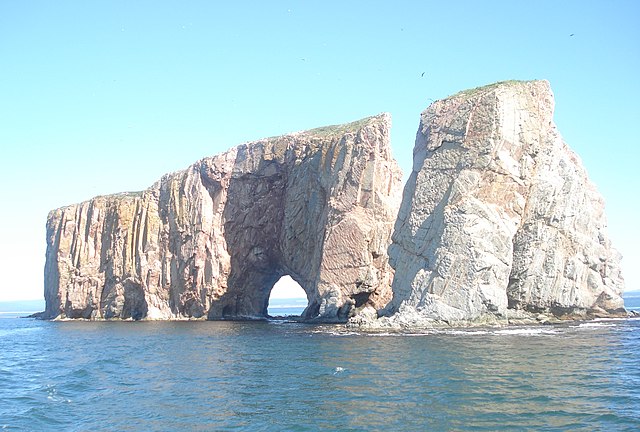
  1. Percé Rock, Quebec, Canada
Perce Rock or the Pierced Rock, Major attraction of Gaspesie region

Image courtesey: Wikimedia
Percé Rock is a French word meaning pierced rock. This natural arch is called by other names such as le rocher percé, Pierced Rock, and Split Rock. When you see this rock from a distance it will look like a ship under sail, wow. Percé Rock is one among the longest natural arches in the world and a major attraction of the Gaspesie region. The park where Percé Rock is situated is the second largest migratory bird sanctuary and one can witness lots of northern gannets here. This is one of the best places to watch blue whale, humpback whale, razorbills, and kittiwakes.

  1. Pont d’Arc, France
Pont d'Arc, France.
Pont means bridge in French; Pont d’Arc is a natural arch carved out by Ardéche River. This is situated near a small town called Vallon-Pont-d’Arc. If you are thinking of canoeing or kayaking in France, Pont d’Arc is the best place. It is one of the most popular tourist attractions in France. You can also find lots of caves near Pont d’Arc, of which one of the famous caves with cave paintings is Chauvet Cave.

  1. Pravčická brána, Czech Republic
Pravacicka brana, natural sandstone arch in Europe

Image courtesy: wikimedia
Pravčická brána is the largest natural sandstone arch in the Europe and one of the most beautiful rock formations in Bohemian Switzerland; it is a natural monument of Czech Republic. This is a very narrow natural arch. There are several divergent paths and stairs that lead to the observation platforms; from here one can enjoy the panoramic view of the surrounding area.

  1. Shipton’s Arch, Xinjiang, China
Shipton's arch, tallest natural arch in the world.

Image source: wikimedia
Shipton’s arch is probably the tallest natural arch in the world. Shipton’s arch is also called as Tushuk Tash in the local language, which mean “Heavenly Gate” and is a conglomerate natural arch. Eric Shipton, a British mountaineer was the first person to report about this arch and hence called the Shipton’s arch. According to the National Geographic team, the height of this natural arch is 1200 feet, which is as high as the Empire State Building in the USA. This arch was listed in the Guinness Book of World Records for some time, but later dropped it as they were not able to locate the exact location of the arch. It was in the year 2000, a team from National Geographic re-found this arch and made an excellent documentary about it.

  1. The Green Bridge of Wales, Pembrokeshire, United Kingdom
The Green Bridge of Wales, Limestone arch, Pembrokshire.

Image courtesy: Wikimedia
The Green Bridge of Wales is a spectacular natural arch in the coast of Pembrokeshire. This natural arch was formed by the erosion of the sea or in other words, marine erosion. This is a limestone arch and is considered one of the biggest natural arches in the world. It is believed that due to coastal erosion, this natural arch may collapse in the long run. It has a rugged picturesque and the views are amazing. It is a place for many caves and natural formations.

  1. The Eye of Burroo Rock, United Kingdom
The Eye of Burroo Rock, largest natural arch, island of Burroo

Image courtesy: wikimedia
The Eye of Burroo Rock is the largest natural arch in the small island of Burroo. It is called the Eye of Burroo as one can notice a large hole in the Burroo when they are miles away; this large hole is what is termed as “The Eye.”

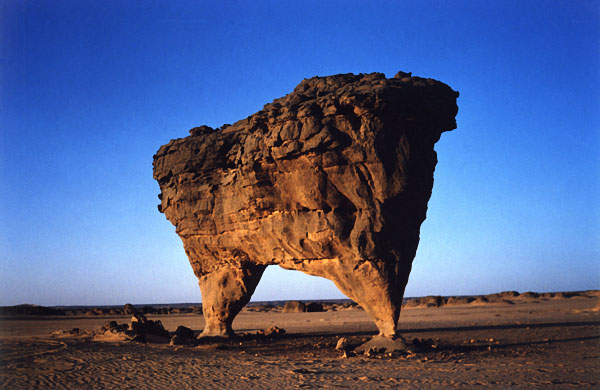
  1. Aloba Arch, Chad
Aloba Arch, longest natural arch outside the US, Ennedi Range

Image courtesy: Naturalarches
Aloba Arch is considered the longest natural arch outside the United States spanning an area of 250 feet. This natural arch is made of sandstone and is located in the Ennedi Range; this range is located within the Sahara Desert. This arch is 394 feet tall and is one among the tallest natural arches of the world.

These natural arches are definitely a must visit tourist attraction. Take a break from the regular routine and visit these breathtaking natural arches around the world.


Related Posts with Thumbnails
Twitter Delicious Facebook Digg Stumbleupon Favorites More